Quick Facts
- Current Slump Factor: The WTI-Brent spread has widened to $25/bbl as of mid-2026, creating pricing friction for domestic producers.
- Core Correlation: XLE maintains a historical 74.1% correlation with West Texas Intermediate prices.
- Expense Ratio: At just 0.08%, XLE remains the most liquid, low-cost vehicle for US energy sector exposure.
- Top Holdings Risk: ExxonMobil and Chevron account for approximately 41% of the total fund weighting.
- Recent Volatility: In 2025, global markets saw WTI decline by nearly 20% while Brent fell by about 19%, setting a bearish tone for the current year.
- Supply Shock: April 2026 saw a massive 10.5 million barrels per day shut-in due to regional instability.
XLE ETF performance is more closely correlated with WTI than Brent because US-listed energy producers use the domestic benchmark to model near-term revenue. When WTI and Brent diverge, US-heavy funds often follow the domestic price as analysts plug WTI figures into cash-flow estimates for major producers and refiners, serving as a critical indicator for identifying energy sector recovery signals for ETF investors.
The WTI Anchor: Why Brent Doesn’t Always Drive XLE
To understand the current volatility in the Energy Select Sector SPDR Fund, investors must peel back the layers of how commodity benchmarks interact with equity valuations. While many global investors look to Brent crude as the primary indicator of the world's oil appetite, XLE ETF performance is tethered much more tightly to West Texas Intermediate. This isn't just a matter of geographic proximity; it is a fundamental pillar of how equity analysts build their valuation models.
When Wall Street analysts forecast the quarterly earnings of a company like Occidental Petroleum or EOG Resources, they don’t start with the price of oil in the North Sea. Instead, they anchor their free cash flow estimates to the delivery point in Cushing, Oklahoma. This regional focus creates a scenario where US energy stocks trade like WTI crude, often ignoring global spikes in Brent if domestic infrastructure constraints keep US prices suppressed. This is particularly relevant in 2026, where we have seen significant commodity futures decoupling.
The divergence between the two major benchmarks can create significant "noise" in a portfolio. If geopolitical tensions lead to a disruption in the Middle East, Brent may spike significantly. However, if that oil cannot easily find its way to North American consumers or if US shale production is ramping up simultaneously, the WTI vs Brent impact on energy stocks becomes apparent: the domestic price may lag, dragging the XLE down even while global energy headlines appear bullish. This benchmark correlation to energy ETFs is the primary reason why many investors felt blindsided by the 2026 spring slump.
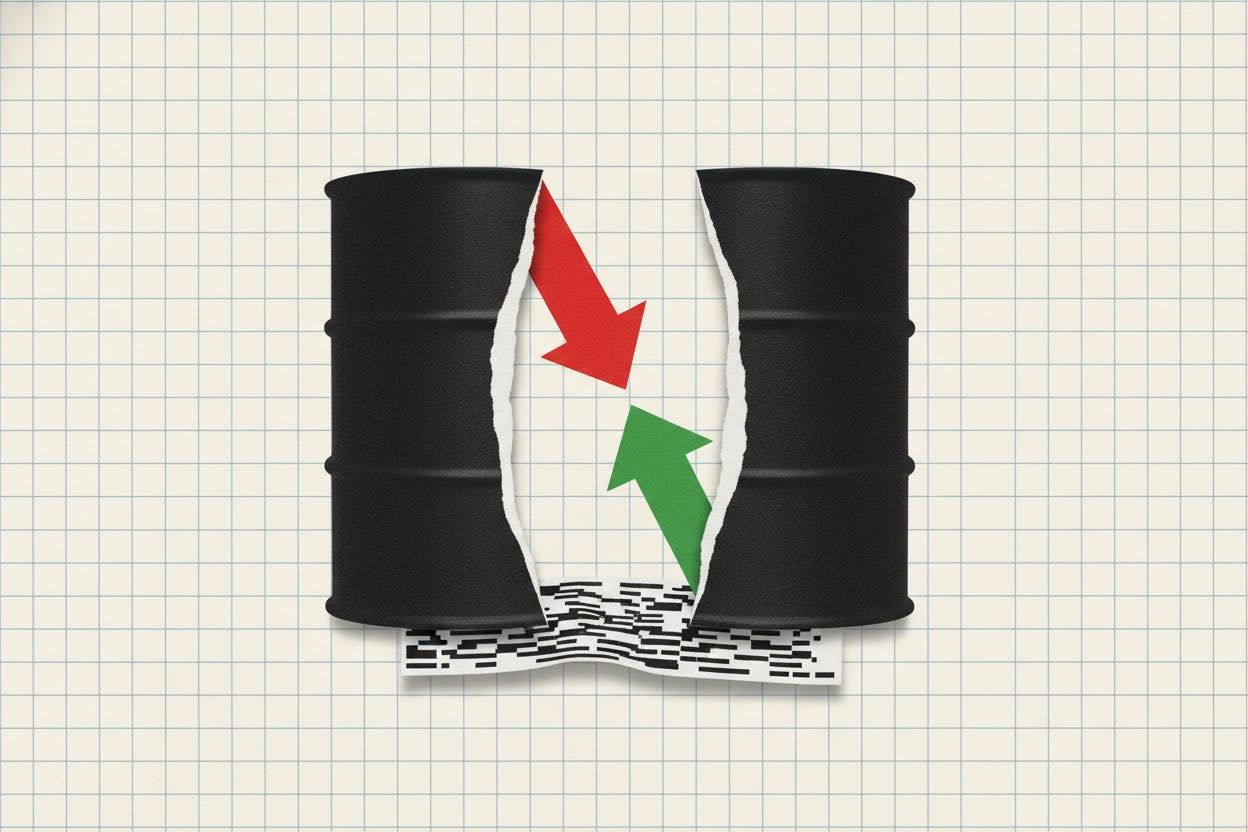
The following table highlights the structural differences between these two benchmarks and how they filter down to the Energy Select Sector Index:
| Feature | West Texas Intermediate (WTI) | Brent Crude |
|---|---|---|
| Primary Geography | Landlocked (Cushing, Oklahoma) | Seaborne (North Sea) |
| Delivery Logistics | Pipeline and storage dependent | Direct access to global shipping |
| Pricing Influence | US Shale production and SPR policy | OPEC+ quotas and global demand |
| Impact on XLE | Direct driver of US upstream revenue | Secondary signal for integrated majors |
| 2025 Performance | Declined by almost 20% | Fell by approximately 19% |
The 40% Rule: How XOM and CVX Weighting Dictates Volatility
One of the most frequent mistakes made by retail investors is treating XLE as a broad, diversified bet on the energy industry. In reality, the performance of the fund is heavily concentrated in just two names. Because the fund utilizes market capitalization weighting, ExxonMobil and Chevron have an outsized influence. Together, these two integrated oil majors represent nearly 41% of the fund’s total assets.
This concentration levels the playing field in some ways but introduces idiosyncratic risks in others. When these large-cap energy stocks underperform due to company-specific issues—such as a shift in project timelines or a miss in downstream refining margins—the entire ETF suffers, regardless of what crude oil is doing at the moment. Conversely, these giants often act as a buffer during price slumps. For instance, Exxon’s commitment to a $20 billion share buyback program provides a technical floor for the stock, which in turn helps stabilize the XLE when commodity prices are wavering.
Understanding how ExxonMobil weighting affects XLE fund volatility is key for risk-aware strategy design. While upstream producers are pure-play bets on the price of a barrel, integrated majors like Chevron have diversified business models that include chemicals and refining. This diversification is why we often see a divergence between upstream producers and oilfield services providers within the same fund. While the drillers are sensitive to immediate price drops, the services companies often stay steadier because their revenue is tied to long-cycle equipment contracts and multi-year infrastructure projects.
For those assessing XLE dividend sustainability during oil price slumps, the concentration in mega-cap stocks is actually a positive signal. These companies maintain much stronger balance sheets than the smaller independent explorers, allowing them to sustain payouts even when the WTI vs Brent crude impact on XLE ETF performance is negative in the short term.
2026 Macro Drivers: Hormuz Disruptions and SPR Dynamics
The energy landscape of 2026 has been defined by extreme geopolitical shifts that have redefined the geopolitical risk premium. Two events stand out as major US energy sector price drivers for 2026 investors. First, the strategic shift in the Middle East, specifically the exit of the UAE from certain OPEC agreements, has introduced a new level of supply uncertainty. Second, the domestic strategy surrounding the Strategic Petroleum Reserve (SPR) has taken a dramatic turn.
In May 2026, the SPR saw a massive 9.1 million barrel drop, a move designed to counteract localized gasoline price spikes. However, such aggressive utilization of the reserve often leads to a "rubber band" effect in markets. Once the market realizes the government's ability to intervene is reaching its limit, technical resistance levels for major stocks often break. This is the macro environment that dictatesthe WTI-Brent spread, which widened significantly in the wake of the Strait of Hormuz disruptions earlier this year.
During these periods of high volatility, we often see a rapid sector rotation. Capital flows out of the cyclical energy producers and into more defensive themes if the price of oil crosses certain psychological thresholds. However, for the long-term investor, these macro shocks often represent an entry point rather than an exit signal. The underlying demand for energy—particularly as emerging markets continue their post-pandemic industrial expansion—remains a powerful tailwind that eventually overrides short-term geopolitical noise.
Technical Thresholds: Levels to Watch for a 2026 Breakout
For those focused on identifying energy sector recovery signals for ETF investors, the technical chart for XLE provides a clear roadmap. The fund has spent much of early 2026 in a consolidation range between $40 and $50. Breaking out of this range would require a sustained move in WTI above the $85 mark, a level that has acted as a ceiling for much of the past twelve months.
Key levels to watch include:
- ExxonMobil Resistance: $126 remains a critical hurdle for the fund’s largest holding; a clean break above this level usually signals a broader sector rally.
- Support Floor: $38 has historically served as a strong support level for XLE during commodity pullbacks, representing a target for value-oriented investing.
- Moving Average Crossovers: Watch for the 50-day moving average to cross above the 200-day average, often referred to as a golden cross, which would suggest the 2026 slump is finally abating.
As we move through the second half of the year, the focus will shift back to corporate efficiency. If the integrated majors can maintain their free cash flow targets despite the WTI-Brent volatility, the technical recovery could be swift. Investors should keep a close eye on the price signals from Cushing, as they remain the most reliable north star for the XLE ETF performance.
FAQ
What factors influence the price of XLE?
The price of XLE is primarily driven by the market valuations of large-cap US energy companies, specifically ExxonMobil and Chevron. These valuations are shaped by the domestic price of WTI crude oil, refining margins, global energy demand, and geopolitical events that impact supply chains. Because the fund is concentrated in integrated majors, corporate capital allocation strategies like share buybacks and dividend policies also significantly influence the fund's price.
Is XLE a good long-term investment?
XLE is often viewed as a core holding for investors seeking exposure to the US energy sector due to its high liquidity and low expense ratio of 0.08%. While it is subject to the cyclical nature of commodity prices, the inclusion of integrated oil majors provides a level of stability that smaller, independent producers lacks. For long-term investors, it serves as an effective hedge against inflation and a source of consistent dividend income.
Is the XLE dividend yield sustainable?
Generally, yes. Because about 41% of the fund is composed of ExxonMobil and Chevron—companies with decades-long track records of maintaining and growing dividends even during market downturns—the yield is considered more sustainable than that of a broader commodity-based fund. These companies use their diversified downstream (refining) and chemical businesses to offset losses when upstream (production) prices fall.
How has XLE performed during high inflation?
Historically, energy has been one of the top-performing sectors during periods of high inflation. Since energy prices are a major component of inflation indices, the revenue of companies within the XLE often rises along with consumer prices. Furthermore, energy producers possess hard assets and commodity inventories that tend to appreciate in value when the purchasing power of the dollar declines, making the fund a popular choice for inflation-aware portfolio allocation.