Quick Facts
- Strategic Reserve: An A$1.2 billion Canberra mineral strategy initiative launching in H2 2026 to stockpile rare earths, gallium, and antimony.
- Financial Benchmark: Investors should seek companies with ASX rare earth stocks with low debt to EBITDA ratios, specifically below 1.5x, to survive market downturns.
- US Policy Shift: The retreat from a guaranteed price-floor backstop has introduced significant revenue uncertainty for Australian rare earth stocks and sector bellwethers.
- Macro Headwinds: Australia's mining and energy export earnings are forecast to decline from estimated A$385 billion in the 2024–25 fiscal year to A$352 billion by 2026–27.
- Sector Performance: Reflecting trade volatility, the S&P/ASX 200 materials sector recorded a 15.3% decline in March 2026.
- Investment Transition: A structural shift from bulk commodities like iron ore toward electrification metals, with gold targets potentially exceeding $4,300 per ounce.
Australian rare earth stocks are currently navigating a complex transition as they move from the prospect of US price-floor protection to Australia's independent strategic mineral stockpiling framework. While the US policy pivot creates short-term revenue uncertainty, the domestic A$1.2 billion reserve initiative aims to stabilize the sector, making financial health and vertical integration the primary filters for long-term investors.
The US Policy Pivot: Navigating Revenue Uncertainty
The landscape for investing in Australian critical minerals shifted significantly in early 2026. For several years, the market anticipated a US-led price-floor guarantee designed to shield Western miners from the aggressive pricing tactics often associated with dominant global suppliers. However, the recent US retreat from this proposed backstop has left many projects facing a reality of intensified revenue uncertainty. Without a guaranteed minimum price, high-cost processing plants become much harder to finance, as lenders lose the "safety net" that once justified aggressive capital expenditure.
This change in the US stance is particularly visible in the sector bellwether performance of companies like Lynas. These large-scale operators are highly sensitive to international policy shifts because their global contracts often rely on long-term price stability. When the US pivot was confirmed, it sent ripples through the ASX, contributing to broader market jitters. Furthermore, the external pressure is compounded by trade tensions; following U.S. policy shifts in 2025, a 10% tariff was applied to most Australian exports, with sectoral tariffs on steel and aluminum reaching 50%.
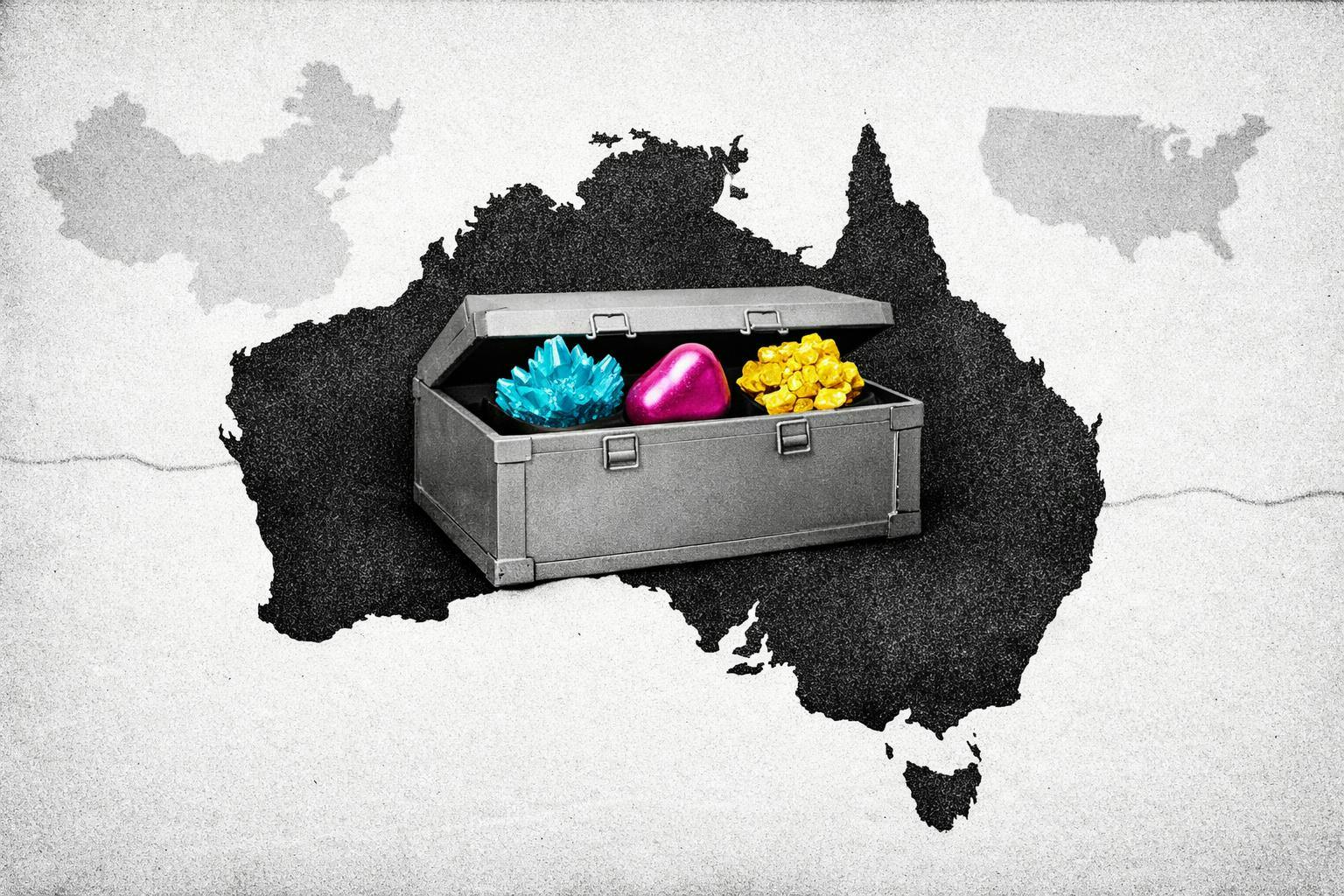
To mitigate this geopolitical supply risk, the Australian government has introduced the Canberra mineral strategy. This A$1.2 billion critical minerals strategic reserve impact is intended to act as 'supply chain insurance.' Scheduled to be operational in late 2026, the stockpile will focus on critical minerals like rare earths, gallium, and antimony. For investors, this domestic intervention provides a localized buffer, even if the impact of US mining price floor pullback on Australian stocks remains a significant headwind for those solely reliant on North American off-take agreements.
Canberra is also exploring targeted supports to provide project security. By facilitating direct offtake agreements for essential industries like defense and automotive, Australia is positioning itself as a more stable, non-China supply alternative in an increasingly fragmented global market.
Financial Health Checklist: Evaluating Sector Volatility
In a climate characterized by valuation compression and rising mining operational costs, investors must shift their focus from speculative growth to balance sheet resilience. In my view, the era of "cheap money" mining exploration is over. Today, evaluating rare earth sector volatility requires a disciplined look at financial health indicators for Australian rare earth mining companies.
A critical metric for any portfolio or strategy design is the debt-to-EBITDA ratio. I recommend a threshold where investors prioritize companies maintaining a ratio below 1.5x. This level of leverage ensures that a company can cover its interest obligations and operational costs even if commodity prices dip or if trade volatility leads to temporary shipment delays. High debt levels in a high-interest-rate environment are a recipe for capital destruction, especially when mining infrastructure projects require years of lead time before generating profit.
Financial Stability Checklist
- Debt-to-EBITDA < 1.5x: Ensures the company can weather price troughs without needing emergency capital raises.
- Positive Free Cash Flow: Look for companies that have transitioned from the exploration phase to actual production and sales.
- Energy Cost Sensitivity: Mining and refining are energy-intensive; companies with access to low-cost or renewable energy sources have a distinct competitive advantage.
- Capital Allocation Strategy: Prioritize management teams that focus on dividend sustainability or disciplined reinvestment rather than aggressive, high-risk acquisitions.
By applying these ASX rare earth stocks with low debt to EBITDA ratios filters, investors can separate the robust operators from those likely to be washed out by the 15.3% decline observed in the materials sector in early 2026. This period of market cooling is necessary to reset valuations to more realistic levels compatible with the high-cost reality of 2027.
Vertical Integration: The Ultimate Survival Filter
The most resilient Australian rare earth stocks are those moving toward vertical integration. Relying on the export of raw concentrates leaves miners vulnerable to the price swings of the global market and the refining bottlenecks controlled by international competitors. To truly offer a non-China supply alternative, Australian firms must possess the capability to process ore into high-purity oxides or metals within domestic borders or through allied partner facilities.
Vertical integration serves as the ultimate defense against the 90% dominance of certain global actors in the refining space. When a company controls the chain from the pit to the refined product, it captures a higher margin and gains more control over its revenue. An excellent example of this trend is the Arafura Nolans project, which aims to produce approximately 4,400 tonnes of Neodymium-Praseodymium (NdPr) annually, with processing capabilities integrated into the site.
The energy transition demand remains the long-term tailwind for these efforts. Whether it is for electric vehicle motors or wind turbine magnets, the need for processed rare earth elements is not going away. However, for an investor, identifying how to evaluate Australian rare earth sector volatility for investors involves looking at whether a company is just "looking for rocks" or if they are building a chemical manufacturing powerhouse. The latter is far more likely to benefit from the investing in ASX stocks linked to Australian critical minerals stockpile initiatives, as the government is specifically targeting refined products for its strategic reserve.
Broadening the Portfolio: Beyond Rare Earths
While this guide focuses on rare earth elements, a risk-aware strategy involves resource sector diversification. The Australian mining landscape is undergoing a massive shift from the old "bulk" model—dominated by iron ore—to a "critical" model focused on copper, gold, and energy minerals. We are seeing a historical contrast between the 2000s boom, which was fueled by Chinese urbanization, and the 2026-2027 transition, which is fueled by global electrification and defense needs.
| Feature | 2000s Mining Boom (Bulk) | 2026 Structural Transition (Critical) |
|---|---|---|
| Primary Driver | Chinese Urbanization & Infrastructure | Global Electrification & Decarbonization |
| Key Commodities | Iron Ore, Coal | Copper, Lithium, Rare Earths, Gold |
| Market Model | High-volume, low-margin shipments | High-value, specialized supply chains |
| Global Context | Globalization & Open Trade | Geopolitical Fragmentation & Stockpiling |
| Price Pivot | Iron Ore > $150/tonne | Gold > $4,300/oz; Copper > $11,800/tonne |
To successfully navigate this period, use a commodity risk matrix to balance your holdings. Rare earth elements sit at the high-risk, high-reward end of the spectrum due to their technical complexity and geopolitical sensitivity. Offsetting this with gold or copper—metals with deeper liquidity and clearer pricing benchmarks—can stabilize a portfolio. Investing in Australian critical minerals 2026 guide trends suggest that while iron ore is softening toward the $85 per tonne range, the "electrification minerals" are entering a multi-year commodity price cycle.
Investor Tip: Diversification is not just about owning different stocks, but owning different risk profiles. Combine the volatility of rare earths with the relative stability of base metals to maintain a smoother equity curve.
FAQ
What are the top rare earth stocks in Australia?
The Australian market is led by Lynas Rare Earths, which is the largest producer outside of China. Other significant players include Iluka Resources, which is developing a rare earth refinery at Eneabba, and Arafura Rare Earths, focused on the Nolans project. Northern Minerals and Meteoric Resources are also frequently watched as emerging developers in the heavy and ionic clay rare earth sectors respectively.
Are Australian rare earth stocks a good investment?
They represent a high-conviction play on the global energy transition and Western supply chain security. However, they are sensitive to geopolitical shifts and require a long-term time horizon. Investors should focus on companies with strong balance sheets and vertical integration capabilities to manage the inherent price volatility of the sector.
What are the risks of investing in rare earth mining stocks?
The primary risks include commodity price volatility, high capital expenditure requirements for processing plants, and geopolitical interference. Many rare earth projects face technical challenges in refining, which can lead to cost overruns. Additionally, changes in government policy—such as the US pullback from price floors—can suddenly impact a project's financial viability.
How does China's rare earth dominance affect Australian stocks?
China currently controls a majority of global mining and nearly 90% of the refining capacity. This allowed them to influence global prices through supply quotas, which can lead to low-price environments that make Western projects uncompetitive. Australian stocks often rise or fall based on the perceived "security of supply" premium that Western nations are willing to pay to reduce this dependence.
Which Australian company is the largest rare earth producer?
Lynas Rare Earths is the largest producer in Australia and the only scale producer of separated rare earths outside of China. The company operates the Mt Weld mine in Western Australia and processing facilities in Malaysia and Kalgoorlie, making it a central player in the global non-China supply chain.